Short answer. Castel Sant’Angelo began in the 130s AD as the tomb that the emperor Hadrian built for himself and his successors on the right bank of the Tiber, finished in 139. In the 5th century it became a fortress, in the Middle Ages and the Renaissance it was a stronghold, prison and refuge of the popes, and in 1870 it passed to the Italian State. It has been a national museum since 1925. This article follows the pages of the museum and of the Ministry of Culture, read on 24 October 2026, and three public-domain guidebooks: Karl Baedeker’s Central Italy and Rome (15th edition, Leipzig, 1909), John Murray’s A Handbook of Rome and its Environs (8th edition, London, 1867) and Augustus Hare’s Walks in Rome (15th revised edition, vol. II, London, 1902). They contain errors and old attributions, so we read them as witnesses of their time. Where sources disagree, we say so.
Entry tickets and guided tours
Castel Sant'Angelo: Entry Ticket + Audio Guide App
4.5· 6,715 reviews
from €22€23
A table of dates
| Date | What happened | Source |
|---|---|---|
| 130s to 139 | Hadrian has a tomb built; Antoninus Pius completes it in 139 | Baedeker, p. 357; the museum |
| 2nd and 3rd century | The emperors are buried here, from Hadrian to Caracalla (217) | Baedeker, p. 357; Murray, p. 71 |
| 5th century | It becomes a fortress; the exact date is uncertain | Baedeker, p. 355; Murray, p. 71; Hare, p. 161 |
| 537 | The defenders resist the Goths’ siege | Baedeker, pp. 355 and 357; Murray, p. 71 |
| 590 | By tradition, Gregory the Great sees the Archangel Michael | Baedeker, p. 357; Murray, p. 71 |
| 10th century | Roman noble families hold the castle | Baedeker, p. 357; Murray, p. 71 |
| 1367 | The keys are handed to Pope Urban V | The museum |
| 1378 to 1379 | The Romans almost destroy it | Baedeker, p. 357; Murray, p. 71; Hare, p. 162 |
| 1395 | Boniface IX has it restored | Baedeker, p. 357; Hare, p. 163 |
| about 1500 | Alexander VI raises the upper part and strengthens the base | Murray, p. 72; Hare, p. 163; the museum |
| 1527 | Sack of Rome: Clement VII takes refuge here | Baedeker, p. 357; Hare, p. 165; the museum |
| 1534 to 1549 | Paul III Farnese turns it into a splendid papal residence | The museum; Baedeker, p. 359 |
| 1644 | Urban VIII builds the outer bastions | Murray, p. 72; Baedeker, p. 357 |
| late 1660s | Clement IX has ten angels placed on the bridge | Murray, p. 9; Baedeker, p. 356 |
| mid-18th century | The bronze angel of Verschaffelt, commissioned for the Jubilee of 1750 | The museum; Baedeker, p. 357 |
| 1849 to 1870 | French garrison | Hare, p. 165; Murray, p. 73 |
| 1870 | Passes to the Italian State as a military prison and barracks | The museum; the Ministry of Culture |
| from 1901 | Restoration under Colonel Mariano Borgatti | Baedeker, p. 357 |
| 1925 | Becomes the national museum | The museum; the Ministry of Culture |
Hadrian’s Mausoleum
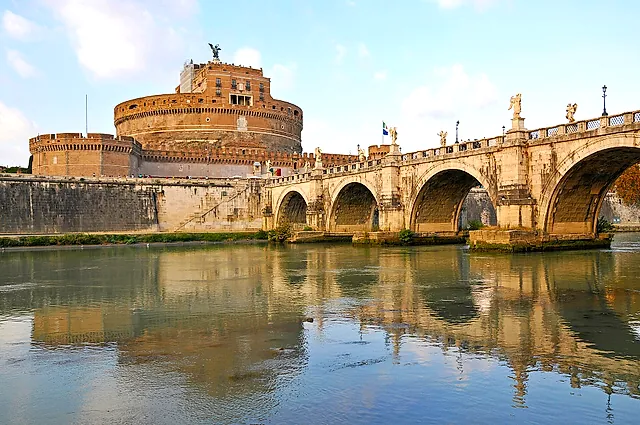
The Ministry of Culture’s page dates the monument only to the 2nd century AD. The old guides give more. Baedeker (1909, p. 357) writes that it was begun in 136 and completed in 139 by Antoninus Pius, Murray (1867, p. 70) says “about A.D. 130”, and the museum’s pages say it began in 135, so we write only that it was built in the 130s. Hadrian died in 138, according to Murray (p. 71), and from him to Caracalla, in 217, the emperors and their families were buried here, says Baedeker. Hadrian’s bridge, the Pons Aelius, joined the tomb to the city.
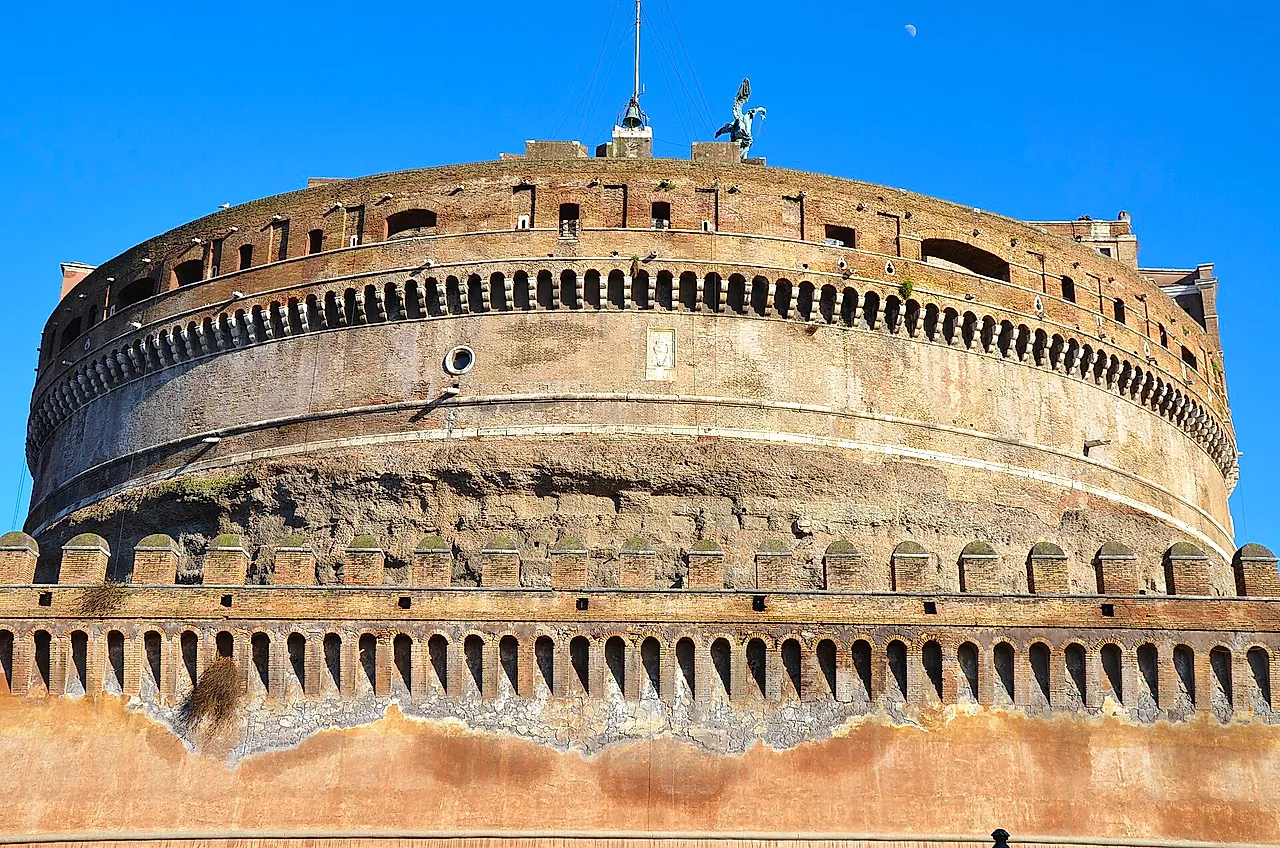
Baedeker describes a square base with a huge cylinder above it, topped, in the reconstructions, by a colossal statue. He calls these reconstructions conjectural, and we do the same. Murray and Hare, retelling Procopius, say that during the siege of the Goths, in 537, the defenders threw the statues of the tomb down on the attackers. We take it as a tale told by a sixth-century historian.
The fortress and the legend of the Angel
In the 5th century the tomb was turned into a fortification guarding the bridge and the city. The date is uncertain: Baedeker suggests 405, Murray and Hare 423, and Italian Wikipedia 403. The museum says only that it was included in the city’s walls and turned into a small fortress. In 537, during the Gothic siege, the fortress held.
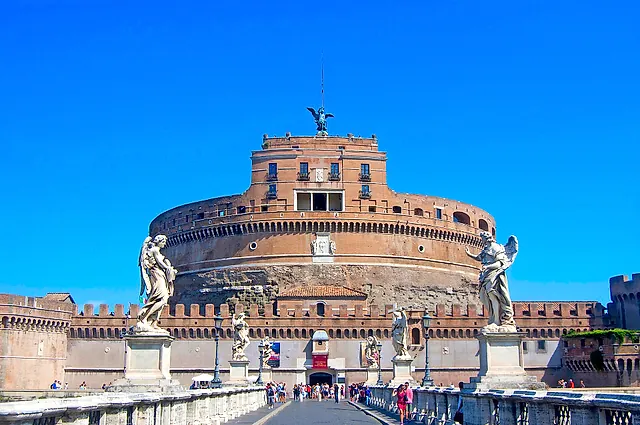
The name comes from a tradition. Baedeker (1909, p. 357) writes that in 590 Gregory the Great, leading a procession against a plague, “beheld the Archangel Michael sheathing his sword above the Castel Sant’ Angelo”. Murray (1867, p. 71) notes that the name “does not appear to have been applied for several centuries after the event”. A chapel and then several statues of the angel followed on the summit. The marble angel by Raffaello da Montelupo is now in the Cortile dell’Angelo, and the bronze one that crowns the castle is by Peter Anton von Verschaffelt, commissioned for the Jubilee of 1750, according to the museum; Baedeker says 1752, other sources 1753.
In the 10th century Roman noble families held the castle as a stronghold. In 1367 its keys were handed to Pope Urban V, according to the museum. The Romans almost destroyed it in 1378 to 1379, and Boniface IX had it restored from 1395.
The Passetto and the residence of the popes
From the late 15th century the popes strengthened the castle. Murray (p. 72) and Hare (p. 163) say that Alexander VI raised the upper part and built a travertine bastion at the base about the year 1500, and Baedeker adds that Julius II extended it. Paul III Farnese (1534 to 1549) made it his residence with the greatest magnificence, according to the museum, with an apartment frescoed by Perin del Vaga.
The Passetto di Borgo is the raised corridor in the Leonine walls that links the Vatican to the castle. On its date, the sources disagree. The museum’s site speaks of a link made in 1277 under Nicholas III Orsini, and says that in 1565, under Pius IV, a new circuit of walls around the Vatican palaces took away its defensive role. Murray (p. 72) and Hare (p. 163) write that it was begun by John XXIII in 1410 to 1411 and finished by Alexander VI, and Baedeker (p. 357) says popes seem to have had a covered passage before the end of the 13th century. We give no single year. Its use is not in doubt. In 1527, during the Sack of Rome, Clement VII took refuge in the castle, where, in Baedeker’s words, he “sustained a terrible siege”. The museum says he went there by the corridor. Hare (p. 165) adds that Alexander VI had used it in 1494, when Charles VIII arrived, a detail we could not confirm on the museum’s site. In 1644 Urban VIII built the outer bastions. For today’s tours of the corridor, read the guide to what to see.
The prison
For centuries the castle was also a prison, and the museum says that from the 17th century it was almost only a political prison. The old guides name famous prisoners with great caution. Baedeker (1909, p. 359) writes that Beatrice Cenci and Benvenuto Cellini “are said to have been incarcerated” here. For Beatrice Cenci, Hare (1902, p. 164) is blunter: “it is very uncertain that she was ever confined here”. Tradition, then, but not a fact. Hare says that a cell of Cellini and the prison of Cagliostro are shown, and that Cardinal Carafa was strangled in the castle in 1561 under Pius IV. Cagliostro was arrested by the Inquisition at the end of 1789 and shut in the castle, according to English Wikipedia, but Baedeker (p. 127) has him die at San Leo in 1795, so we do not write that he died here.
The castle also appears in opera. The third act of Puccini’s Tosca, which opened at the Teatro Costanzi in Rome on 14 January 1900, is set here, and the museum’s site mentions the opera.
From 1870 to the museum
French artillery was based in the castle in 1867, according to Murray (p. 73), and Hare (p. 165) gives the French presence as 1849 to 1870. In 1870 the castle passed to the Italian State as a military prison and barracks, say the museum and the Ministry of Culture. Hare notes that part of the outer bastions was demolished in 1887, and Baedeker that the Ponte Sant’Angelo was restored in 1892 to 1894 with the regulation of the Tiber. Restoration of the castle began in 1901 under Colonel Mariano Borgatti. After exhibitions and a reorganisation between 1911 and 1925, it became a national museum in 1925.
Recent years have brought new rooms. The Appartamento del Castellano opened to the public on 11 December 2024, the Passetto di Borgo reopened with guided tours on 23 December 2024, and the Sale Farnesiane reopened on 20 June 2026. The museum belongs to the state and is part of the Pantheon and Castel Sant’Angelo institute of the Ministry of Culture. For what you can see today, read what to see. For the rules on the day, see the visit tips, and for the prices and the ID rule, the tickets guide.