Short answer. Castel Sant’Angelo is a stack of periods: the Roman ramps of Hadrian’s mausoleum at the bottom, medieval walls and courtyards above them, and the apartments that Renaissance popes decorated near the top. The museum’s pages do not describe a room-by-room route, so this article follows what they name, the 1909, 1867 and 1902 guidebooks of Baedeker, Murray and Hare, and the museum’s announcements, all read on 24 October 2026. Rooms, exhibitions and works change, so check the museum’s site before you go.
Entry tickets and guided tours
Castel Sant'Angelo: Entry Ticket + Audio Guide App
4.5· 6,715 reviews
from €22€23
What changes the route today
The museum warns that since 3 December 2024 the circular route through the ambulatory of the ground floor may be diverted, because of works to improve accessibility. It says you can begin from the Dromos, in front of the entrance, and carry on up the ramp to the Cortile dell’Angelo. A temporary ticket office stands outside the castle while the reception areas are renovated, and the museum also mentions restoration works and a “multimedia square”. It does not say when they end. See the visit tips for the rules.
The Roman ramps and the mausoleum
The visit begins in what is left of Hadrian’s tomb. Baedeker (1909, p. 359) describes a square chamber with a niche for a colossal statue, a spiral passage and, at the centre, the burial chamber with four niches for urns. John Murray’s 1867 handbook (p. 72) says the spiral corridor was brought to light by excavations begun around 1825, and Hare (1902, p. 164) calls it a passage “up which a chariot could be driven”. The museum names the Dromos, the helical ramp and the Sala delle Urne among these Roman spaces. To follow the story of the tomb, read the history of the castle.
Cortile dell’Angelo and Cortile di Alessandro VI
At the top of the ramp you reach two courtyards. In the Cortile dell’Angelo, Baedeker (1909, p. 359) places the marble angel by Raffaello da Montelupo, which stood on the summit before the bronze one replaced it. The Cortile di Alessandro VI is the curved one; Alexander VI is the pope who strengthened the castle around 1500. The rooms of the former armoury that open on the courtyards have housed “Panopliæ” since 20 June 2026, an exhibition of the museum’s historic weapons in six rooms. Since 12 April 2022 the lower armouries have also had an educational exhibition with models on the history of the monument.
The papal apartments and the Sale Farnesiane
The upper floors hold the apartments of the popes. Pope Paul III Farnese (1534 to 1549) brought the castle to the height of its splendour as a residence, according to the museum. The Sale Farnesiane reopened on 20 June 2026, and the museum lists these rooms.
- Sala di Amore e Psiche, arranged as a Renaissance bedroom.
- Sala del Perseo. Baedeker (1909, p. 359) calls it Paul III’s private apartment, with a frieze by Perin del Vaga. The museum places a Saint Jerome by Lorenzo Lotto here.
- Sala Paolina. Baedeker gives its frescoes, on stories of Alexander the Great, to Perin del Vaga, and notes the rich stucco ceiling.
- Sala dell’Adrianeo and Sala dei Festoni. In the 19th century they were papal prison cells, and they now hold works from the permanent collection, which the museum says includes an altarpiece by Luca Signorelli and a polyptych from the workshop of the Zavattari.
The museum’s website also shows a “Sala di Apollo” and a “Sala della Biblioteca” only as photo captions, with no text, so we cannot describe them. The Loggia di Giulio II, which Baedeker reaches from the end of the Sala Paolina, is listed in the museum’s virtual tour; the museum explains that some spaces are hard to reach and offers them virtually. We could not confirm whether it is open to visitors in person.
The Appartamento del Castellano
This apartment was built in 1730 to 1731, according to the museum, and has been open to the public since 11 December 2024, with a permanent exhibition on the Girandola fireworks. It now hosts “Fuochi sul Tevere” until 22 November 2026.
The angel, the terrace and the view
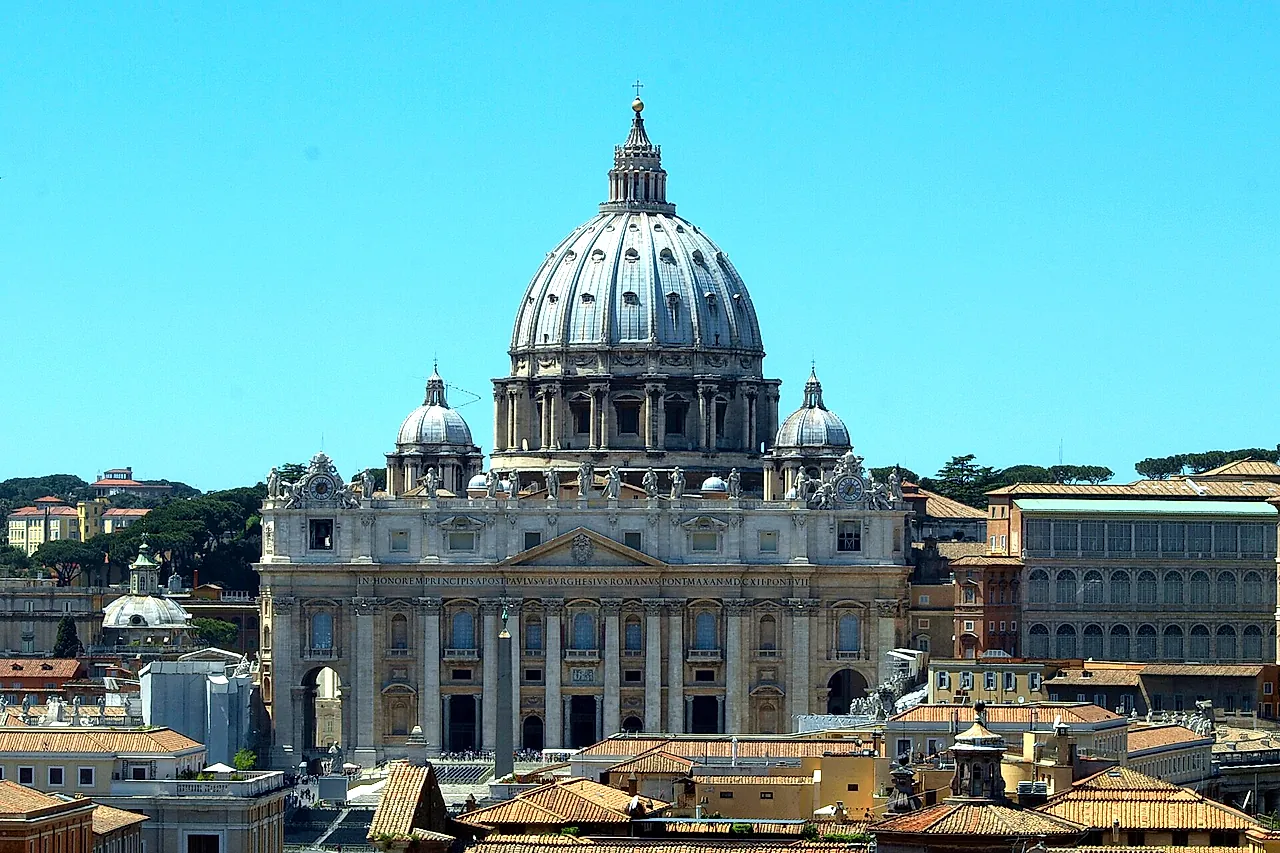
On the summit stands the bronze Archangel Michael by Peter Anton von Verschaffelt, commissioned for the Jubilee of 1750, according to the museum. The sources give 1752 or 1753 for its placing, and the guidebooks agree that it replaced a marble angel. Baedeker (1909, p. 359) writes of a “beautiful view of St. Peter’s” from the platform, and Murray (1867, p. 73) says no other point shows the basilica “to more advantage”. Those are opinions of their day. The museum’s website shows a “Terrazza dell’Angelo” among its photos, but it gives no sentence saying whether or when the terrace is open, so do not plan around it.
The prisons
The castle was a prison for centuries, and the museum says that from the 17th century it was almost only a political prison. Baedeker (1909, p. 359) mentions stairs down to the dungeons “where Beatrice Cenci, Benvenuto Cellini, and others are said to have been incarcerated”, and in his day they were not shown on Sundays. The pages we read do not say that the old cells are on today’s route, so we do not promise them. The former papal prison cells now used as the Sala dell’Adrianeo and the Sala dei Festoni are open as exhibition rooms, and the Cappella dei Condannati is now a conference room.
The Passetto di Borgo
The raised corridor along the old walls that links the Vatican to the castle opens only on guided tours sold apart from the ticket, and the corridor is not visitable on the first Sunday of the month. The tours are on Friday to Sunday from 9:00 to 13:00 with entry to the castle included, on Saturday evening from 19:00 to 23:00, and on the second and fourth Sunday at 10:45 and 12:15 for the easier-access visit, which starts at the Torre del Mascherino and does not enter the castle. It reopened to the public on 23 December 2024. Hare (1902, p. 165) wrote that it was “intended for the escape of the Popes”. Prices and length are not confirmed by the official pages we could read. See the tickets guide for the tours sold by our partner.
The Ponte Sant’Angelo and Bernini’s angels
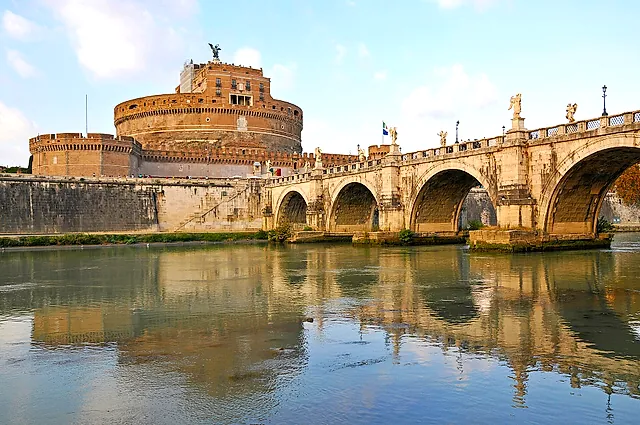
Outside the museum, the bridge began as Hadrian’s Pons Aelius, built to reach the tomb. According to Baedeker (1909, p. 356) only the three central arches are ancient, and the bridge was restored in 1892 to 1894. The statues of Saint Peter and Saint Paul were put there under Clement VII, in 1530. The ten marble angels were placed under Clement IX in the late 1660s on a design by Bernini. Baedeker and Hare give the year 1688, which cannot be right for that pope’s reign. Murray writes that the angel with the cross is by Bernini and the others by his pupils, while English Wikipedia and Hare say Bernini carved only two himself, now in Sant’Andrea delle Fratte. The bridge is about 130 m from the castle in a straight line.
Exhibitions on 24 October 2026
The dates below come from the museum’s and the Ministry of Culture’s event pages on 24 October 2026 and can change.
- Cambellotti, “Tutto diventa forma”, in the Sale Cambellotti, until 25 October.
- “Ercolano. L’arte di vivere”, until 1 November.
- “Fuochi sul Tevere”, in the Appartamento del Castellano, until 22 November.
- “Luchino Visconti e la messa in scena della storia”, until 29 November (the start date is given as 17 and 23 October on different official pages).
- “Panopliæ”, since 20 June, with no end date that we could read.
The pages we read mention no extra ticket for them, but the Ministry of Culture notes that some temporary exhibitions in state museums can cost extra, even for people with free entry. We could not confirm this for these shows.
How long should I plan?
The museum states no duration for the ordinary visit, and it proposes no itinerary, so we do not invent either. Our own suggestion, which is not the museum’s: pick two or three areas from this list before you go, and check the opening hours for the last entry at 18:30.